

Alternate row background colour in Reporting Services
- Category: SQL Server Reporting Services
- Hits: 38397
This is just a note for me as it took a while to find on the net and even then it was confusing as to why it works but it does. Not sure whether you call this an MDX Query or part of a Transact-SQL mashup. You need to go to "Fill" (of each text box in the row - unless there's a faster way) and instead of color, click on the expression button (fx) and use the following:
=IIF(RowNumber(Nothing) Mod 2, "#ffffff", "#eeeeee")

or

=IIF(RowNumber(Nothing) Mod 2, "WhiteSmoke", "Garamond")
This is telling the report to be white (=#ffffff) in row 1 (odd row numbers) and a very light grey (=#eeeeee) in row 2 (even row numbers). The first row being of all rows in the dataset and not for a particular drill-down item. It will alternate between the two for the rest of the report. [The second example is what I use most frequently].
Parameters not being used in report processing
- Category: SQL Server Reporting Services
- Hits: 34665
Problems:
- Given a date, the date format was reverting to US format as opposed to European
- Given a Campus as a text value, the SQL query was ignoring this completely
- Hardcoding the scalar local variables worked
Change Regional Settings for your Report
- Category: SQL Server Reporting Services
- Hits: 37063
Basically I thought that the regional settings of a report generated using Report Builder 2.0 on a MS SQL Server 2008 instance were dependent on either the server or the client machine. Realised that this was actually specified in the report. Here's a quick note on how to set Dates and Times used in parameter fields to UK format (dd/MM/yyyy).
Report Builder 2.0 - Hide Series1
- Category: SQL Server Reporting Services
- Hits: 36903
- SQL Server 2008
- Report Builder 2.0
- BMC Service Desk Express 9.8
- Incident #
- Group Name
- Close Date & Time
- Assigned to Full Name
- Incident Type
If Then Else in Report Builder 2.0 Expressions
- Category: SQL Server Reporting Services
- Hits: 47840
Yes, well don't laugh, I could not find this on the WWW so I was obviously not using Google properly. Anyway here's just a quick note on how to do if else statements in Report Builder 2.0
I'm looking at the following if statement:
If (MyFieldName = 0) Then
     Return 1
Else
     Return MyFieldName
Can be expressed as:
IIf(Fields!MyFieldName.Value = 0, 1, Fields!MyFieldName.Value)
SSRS Report Builder 2.0 - Error during processing
- Category: SQL Server Reporting Services
- Hits: 25841
The Issue
After modifying a report and on running it, Report Builder 2.0 returns the following error:

An error occurred during local report processing.
An error has occurred during report processing.
Query execution failed for dataset 'DataSet1'.
The variable name '@GroupName' has already been declared. Variable names must be unique within a query batch or stored procedure.
SharePoint 2007: Change profile picture with minimal permissions
- Category: SharePoint
- Hits: 19509
This is a quick article on how to change your profile picture in your company's sharepoint site. Sounds straightforward but without being allowed to upload images or edit other profiles, each user has to do this with the permissions they've been given.
Why?
Because I can
How?
About 5 seconds worth of fun
- Category: SharePoint
- Hits: 18296
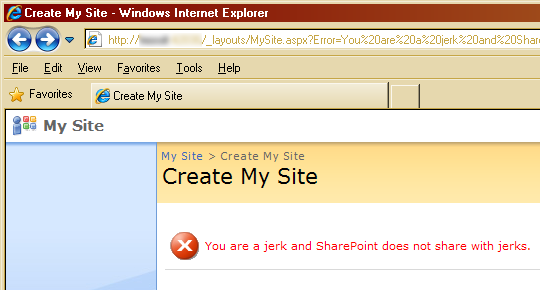
Really not work related but if you know your sharepoint site:
Custom Error
http://<My_SharePoint_Site>/_layouts/MySite.aspx?Error=You%20are%20a%20jerk%20and%20SharePoint%20does%20not%20share%20with%20jerks.
Installer?