


SSRS Zero Padding
- Category: SQL Server Reporting Services
- Hits: 224677
I didn't want to do this at the database level, mainly because it meant modifying the SQL query. The zero padding would need to be applicable within an MDX query.
The Situation
We have a database using Oracle 10g, and a SQL Server Reporting Services v2008 R2 environment. My use for this was when displaying an audit log displaying the oracle errors.
Oracle Errors
An Oracle error usually returns in the format of -12345. If we want to look them up the error is ORA-12345. Unfortunately Oracle also returns errors of less than 10000 so ORA-00201 would actually be returned as "-201". As I wanted a link so that the user can just click on this link and it would take them to http://ora-00201.ora-code.com/.
SSRS AlphaNumeric Parameter Validation
- Category: SQL Server Reporting Services
- Hits: 33078
If you ever want to check the parameters submitted with a report for alpha numeric characters (so it doesn't contain symbols, punctuations, etc) then you should do this at the database level, and then get the report to complete the check:
The Plan
- User enters value in parameters and clicks on "View Report"
- Report passes parameter to dataset which gets formatted by the database
- Report retrieves (select) formatted parameter as a field value to use
- Report loads with changes based on returned value.
The Gist
- Add database level parameter check
- Add IIF in SSRS to confirm
SSRS Retrieving Oracle Stored Procedure Success or ErrorLevel
- Category: SQL Server Reporting Services
- Hits: 56009
We have a report in SQL Server Reporting Services 2008 R2 (SSRS) reading from an Oracle 10g database which works great and lists all the details on a specific student. An additional request is that there appears a link that will run a stored procedure which
- Updates a timestamp in an existing table
- Inserts a row into an audit table
How?
Reminder on SSRS row separator
- Category: SQL Server Reporting Services
- Hits: 29227
- XP SP3 Workstation
- Business Intelligence Development Studio 2008 (BIDS)
- SQL Server Reporting Services 2008 R2 (SSRS)
I have a report displaying room bookings. Each row lists the day, date, room name, start/finish times, booking details and the staff contact. I want an empty row to appear between each day in the list, so I have:
SSRS Repeat Headers in PDF Report
- Category: SQL Server Reporting Services
- Hits: 34577
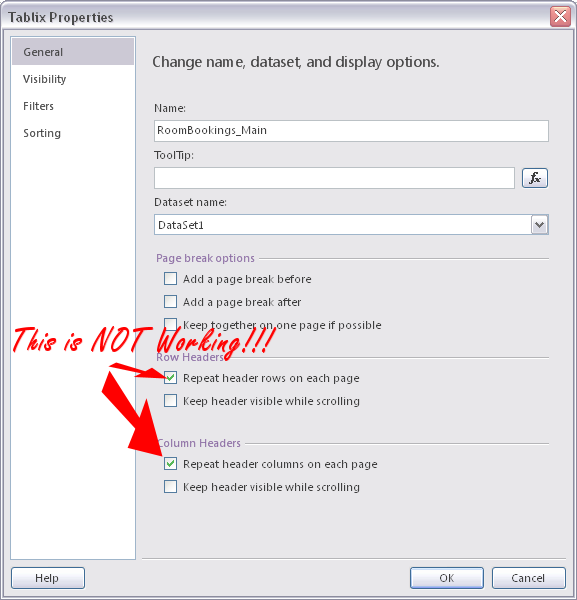
I've set some tablix headers but when I request the same report in PDF format, the tablix headers only appear once on the first page. Every subsequent page simply displays the report header (which does not include the tablix header... obviously). I right-clicked on the header row of the tablix and checked the box "Repeat header columns on each page.

SSRS External Images don't display
- Category: SQL Server Reporting Services
- Hits: 108413
We want some photos taken from another website of ours to display in our report. These are not stored locally on the Reporting Server because other services use these photos on our Intranet and we only want one location to upload the photos. These images are provided via a website address (http) or network share (file).
Before you ask, we have several MS Sharepoint sites but we didn't go down the route of uploading 10000+ images into a Sharepoint database though we are still considering it; so this article is more about just getting external images to display when they are provided over an authenticated URL (You shouldn't be having any issues with this if the image is available to anonymous users - eg. Google Logo).
Our Setup
- Windows XP Workstation
- Business Intelligence Development Studio 2008 (BIDS)
- SQL Server 2008 R2 Reporting Server (SSRS) running on Windows Server 2003
- Team Foundation Server 2010 (TFS)
Problem #1: Image does not appear within SSRS
When previewing the report in BIDS, the photo appears fine. If we deploy the report to our Reporting Server and attempt to view it using a Web-Browser, the image does not display:
- Get report to see images hosted on an external URL
- Check if image exists to display alternative placeholding image.
SSRS Parameters in Oracle Stored Procedure
- Category: SQL Server Reporting Services
- Hits: 64302
So this is regarding an error when trying to add parameters to a Stored Procedure of an Oracle database from within Microsoft SQL Server Reporting Services.
The Error
ORA-00911: invalid character
ORA-06512: at "SYS.DBMS_UTILITY", line 114
ORA-06512: at line 1 (System.Data.OracleClient)
The Situation
I'm using Business Intelligence Development Studio 2008 to develop a Reporting solution on a Windows XP workstation. We are connecting to a SQL Server 2008 R2 Reporting Service (SSRS) with Team Foundation Server 2010. The database with our stored procedure is Oracle 10g.
The Stored Procedure
Rather than a returned dataset, our Stored Procedure updates a field in one of our Oracle tables and returns nothing. It accepts 3 parameters: The StudentID (reference) varchar2, Username (who's running the report) varchar2 and a JobID (request reference) number.
SSRS Redirect after a report is run
- Category: SQL Server Reporting Services
- Hits: 33669
This article serves to describe several workarounds or proofs of concept.
Why?
We have a first report which acts like a search page. You enter the student you are looking for by reference or name and if there is only 1 result in the results page, then we want it to redirect to the details report for that student automatically.
How?
So there are various solutions out there, here's an overview of some:
Method #1
- Create one report with all selectable reports as subreports - toggle visibilty based on parameter.
Method #2
- Add a button below "View Report" linked to some script code (requires change to ASP pages on the ReportingServer, ie. affects all reports on that server).
Method #3
- Use ASP instead of SSRS.
Method #4
- Use a TimeInterval refreshing the page after a certain time.
Conclusion
In the end, this came down to a design decision. Time spent on trying to find a solution was not considered to be warranted. My reports use a parameter for the connection string to specify which server and database to connect to and the follow on link was enough as a solution. My seniors advised that if we had time in the future we could expand on this further.
Google Searches that got me nowhere:
- ssrs process parameter after report execution
- auto-redirect after are a report is run
- ssrs vbscript post report processing
- ssrs auto redirect based on a dataset value